with Fuya Fuya, Chimborazo, Cotopaxi, Pichincha, Loma Corazón and Imbabura
Acclimatization takes place around Guandera and Otavalo.
This is a fascinating circuit through Ecuador’s volcanic landscapes. We visit Quito, Guandera, Laguna Cuicocha, and climb Fuya Fuya, Imbabura and Pichincha for acclimatization before tackling the two great volcanoes Cotopaxi and Chimborazo.
Join us on a journey through Ecuador – a land of contrasts: vast sandy beaches, impenetrable rainforest, and volcanoes rising over 6,000 meters. Despite being smaller than former West Germany, this country offers extraordinary diversity. Our tour focuses primarily on the Andean regions.
After arriving in Quito, we spend the first two days in the capital, exploring the colonial old town in particular. At around 2,800 m above sea level, the altitude is noticeable, but this is easily compensated by one of the most beautiful cities in Latin America.
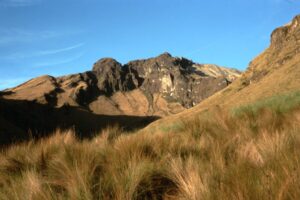
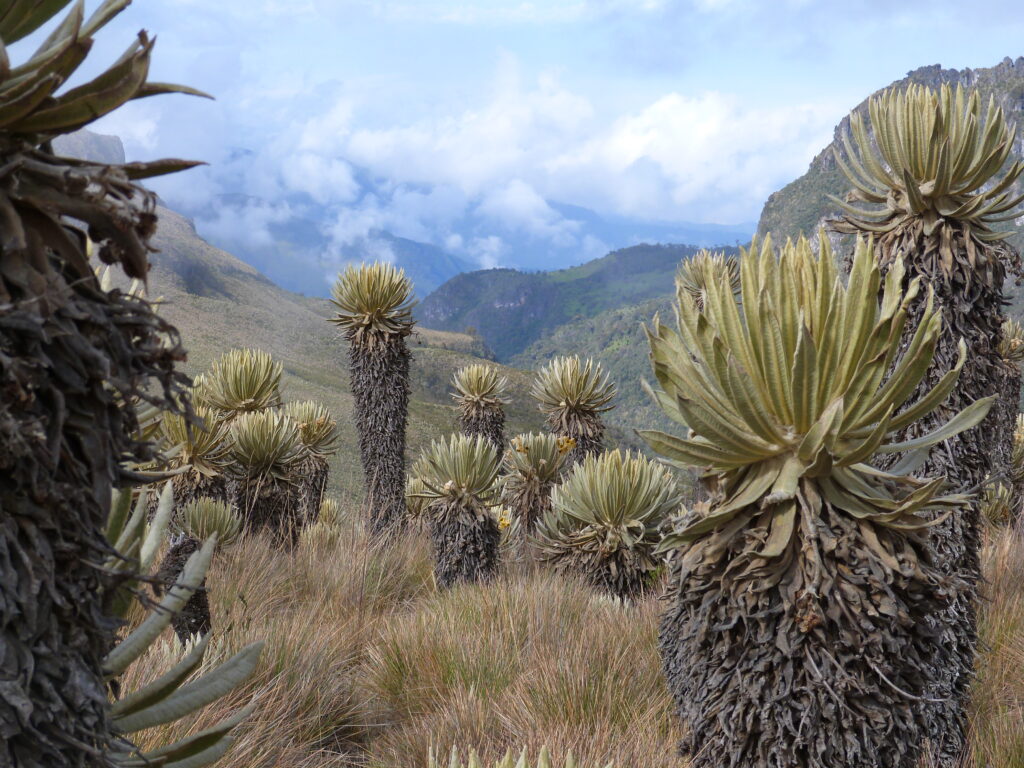
From Quito we follow the Avenue of the Volcanoes northwards to the lively Andean town of San Gabriel. Nearby lies the Guandera Ecological Station, situated in dense mountain rainforest. From here we undertake several acclimatization hikes into the paramos, where with a bit of luck we may encounter pumas or the rare spectacled bear.
We then move on to Otavalo, famous for its Saturday indigenous market. Otavalo is also the starting point for our first major ascents of Fuya Fuya (4,293 m) and Imbabura (4,682 m). Along the way we visit the “White City” of Ibarra.
By now we should be well acclimatized to attempt Cotopaxi, one of the most beautiful volcanoes in the world. Its brilliant white cone is already visible from Quito, where the ascent begins. Overnight accommodation is at the José Ribas Refuge at 4,800 m, roughly the height of Mont Blanc.
Although Cotopaxi was recently remeasured and is now officially 5,895 m (previously considered a 6,000 m peak), it remains an imposing and iconic mountain.
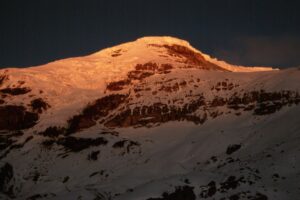
A true 6,000-meter peak awaits us next: Chimborazo (6,268 m), the highest mountain in Ecuador and the highlight of the trip. The ascent starts from the charming Andean town of Riobamba, with an overnight stay at the Whymper Hut just above 5,000 m. Nearly 1,300 demanding vertical meters remain for the summit push, requiring good physical fitness and basic mountaineering experience, particularly on snow and ice.
Volcanoes and high-altitude landscapes
Nature reserves
Guandera Ecological Station
Laguna Cuicocha
Fuya Fuya
Imbabura
Pichincha
Northern Ecuador
La Esperanza
Otavalo
Quito
Cotopaxi
Chimborazo
Duration: 20 days
05 July – 24 July 2025
03 January – 22 January 2026
05 July – 24 July 2026
03 January – 22 January 2027
Individual dates available on request.
From 2 participants: €2,855
From 4 participants: €2,745
From 6 participants: €2,545
Airport transfers
All land transfers by bus and taxi
Accommodation in simple local lodgings and mountain huts
Local tour leadership
National park entrance fees
Organized ascents of Cotopaxi and Chimborazo including guides, meals, and rental equipment
Guided hikes
International flights
Travel accident and health insurance
Baggage and trip cancellation insurance
Meals and drinks not listed
Tips
Personal expenses
Minimum: 2
Maximum: 10
Good general fitness is essential
Ice and snow experience is advantageous but not mandatory
Extensions and additional tour modules available
Day 1: Arrival in Quito
Day 2: Panecillo, historic center, Mitad del Mundo
Day 3: Drive to San Gabriel and Guandera
Day 4: Acclimatization hike – Loma Corazón
Day 5: Mirador hike
Day 6: Transfer to Otavalo
Day 7: Laguna Cuicocha & market
Day 8: Ascent of Fuya Fuya
Day 9: La Esperanza & countryside hike
Day 10: Ascent of Imbabura
Day 11: Return to Quito
Day 12: Preparation for Cotopaxi
Day 13: Ascent of Pichincha
Day 14: Cotopaxi National Park – José Ribas Refuge
Day 15: Summit day Cotopaxi
Day 16: Rest / reserve day in Quito
Day 17: Transfer to Chimborazo – Whymper Hut
Day 18: Summit day Chimborazo
Day 19: Reserve day in Quito
Day 20: Return flight
The approach to Quito is one of the most spectacular flights in South America. Although the new airport no longer requires flying between skyscrapers as in the past, the view over the elongated metropolitan area of nearly three million inhabitants, nestled in the Andes, remains impressive. The volcanoes Cotopaxi, Pichincha and Illiniza, which we fly past at close range, add to the dramatic scenery.
Upon arrival in Quito, we transfer to our hotel. Depending on arrival time, there may be some opportunity to explore the city independently.
► Airport pick-up and transfer to Hotel Auberge Inn (or similar; applies to all hotels).
(-/-/-)
On our second day we already climb our first “3,000-meter peak”: El Panecillo, crowned by the large aluminum statue Virgen de Quito. From here we enjoy panoramic views over the entire city and visit a small local market.
Later we explore Quito’s colonial old town. While it is impossible to see everything in one day, highlights include Plaza de la Independencia, the Government Palace, the Cathedral, Casa de Sucre, and San Agustín Church. To conclude the day, we visit the Equator Monument “Mitad del Mundo”, marking the (historically mismeasured) center of the world.
► Approx. 5–6 hours of sightseeing including drive to Mitad del Mundo.
Hotel Auberge Inn. (B/-/-)
We follow the Avenue of the Volcanoes northward to the lively Andean town of San Gabriel on a highly scenic drive. If time allows, we briefly explore the town.
Nearby lies our destination, the Guandera Ecological Station, located in dense cloud forest. By taxi we travel to Mariscal Sucre, a small settlement on the high plains of the Eastern Cordillera. From here, a hike of about one hour leads us to the station at approximately 3,400 m.
In the afternoon we explore the surroundings of the station. Dinner is a simple, traditional meal served at Guandera.
► Approx. 4 hours driving plus 30 minutes ascent by vehicle to Mariscal Sucre.
Hike: approx. 2 hours, 300 m ascent. (B/-/D)
Today we undertake an acclimatization hike into the paramos, where with some luck pumas or the rare spectacled bear may be seen. Our first summit is Loma Corazón (approx. 3,800 m), an ideal acclimatization peak.
We spend the entire day hiking through pristine primary forests, cactus zones, and shrubs, enjoying sweeping views over the vast Ecuadorian paramo landscapes. After the hike we visit Guandera’s conservation projects, including the pools (Piscinas), the weather station, and potato fields.
Guandera is operated by the environmental organization Jatun Sacha, based in Quito, which also runs two other ecological stations in Ecuador.
Dinner and overnight stay at Guandera Station.
► Approx. 5 hours hiking, 600–700 m ascent (variable). (B/L/D)
Today’s hike is longer. We cross several smaller paramo summits and climb Mirador (over 4,000 m). Well-established paths exist in the park, although occasional signs of human impact can be seen.
The surrounding landscape is stunning, featuring dense cloud forest, wide steppe-like terrain, and even a beautiful waterfall. Early starts increase the chance of wildlife sightings, though encounters with pumas or spectacled bears remain rare.
The views surpass those of the previous day, and on clear days we can even see Colombia. Dinner and overnight again at Guandera Station, sharing the evening with station staff and volunteers.
► Approx. 7 hours hiking, 800–900 m ascent (variable). (B/L/D)
We descend from Guandera to Mariscal Sucre and return by taxi to San Gabriel, then continue by road to Otavalo. After checking into our hotel, we enjoy dinner at a local restaurant, possibly accompanied by traditional Andean street musicians.
► Approx. 2 hours descent (400 m). 3–4 hours driving.
Hotel Coraza. (B/-/-)
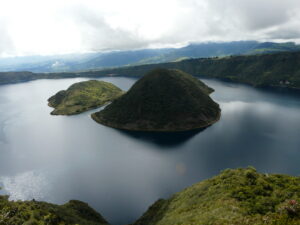
We visit the spectacular Laguna Cuicocha, one of Ecuador’s most impressive natural wonders. This 200-meter-deep, intensely blue crater lake contains two islands: Isla Teodoro Wolf and Isla Yerovi.
A well-maintained circular trail allows us to hike around the lake, with constant views of the water far below. The area lies within the Cotacachi–Cayapas Ecological Reserve (200,000 ha). Wildlife sightings are possible, though rare.
Optional boat trips are available, and there is a small restaurant serving fresh trout. The extinct volcano Cotacachi (4,939 m) dominates the scenery above the lake.
► Approx. 1 hour drive. 4–5 hours hiking, 500 m ascent/descent.
Hotel Coraza. (B/-/-)
From Otavalo we drive to Laguna Mojanda, a deep-blue crater lake. From here we ascend the extinct volcano Fuya Fuya (4,293 m). Most of the route follows good trails; near the summit ridge the terrain becomes rockier and hands may occasionally be needed.
After enjoying panoramic summit views, we descend and partially circle the lake, admiring the dark rock formations of Yana Urku.
► Approx. 1 hour drive. 4–5 hours hiking, 600 m ascent.
Hotel Coraza. (B/-/-)
We travel toward Ibarra, optionally visiting the “White City.” Afterward we continue to the tranquil mountain village La Esperanza, surrounded by fields and farmland.
A gentle walk through flowering agricultural landscapes allows us to stretch our legs without overexertion, as the ascent of Imbabura awaits the next day.
► Approx. 2 hours driving. Short hike (~2 hours, minimal elevation).
Hotel Casa Aida. (B/-/-)
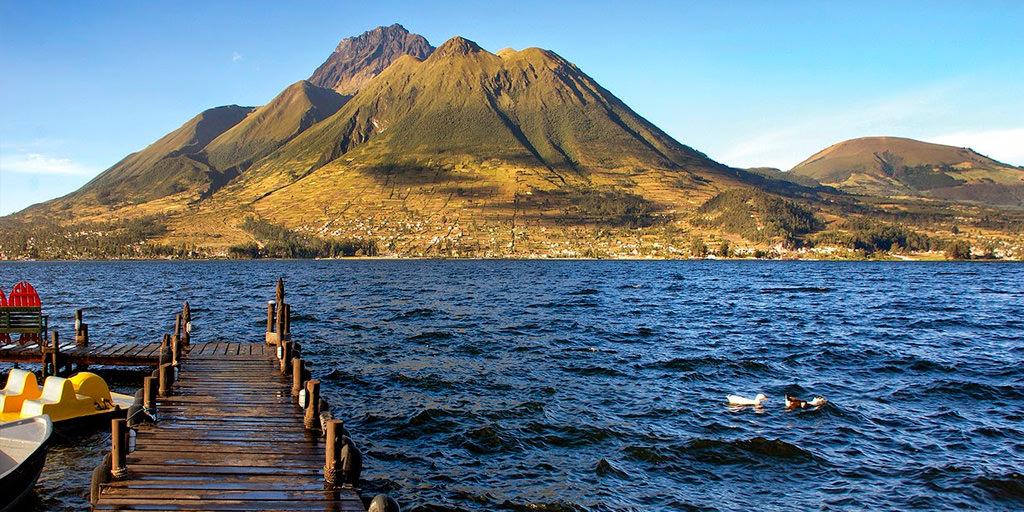
From La Esperanza we ascend Imbabura, also known as Taita Imbabura, revered alongside Cotacachi as a sacred mountain. The route is non-technical, with no glacier or snow, and manageable rocky sections.
After reaching the crater rim, we traverse to the main summit, enjoying impressive views down to the city of Ibarra. Descent follows the ascent route. Dinner and overnight again in La Esperanza.
► Approx. 2 hours driving. 6–7 hours hiking, 1,300 m ascent.
Hotel Casa Aida. (B/-/-)
We return via Ibarra to Quito by bus. After checking into the hotel, the afternoon and evening are free to explore the city or enjoy Quito’s nightlife, especially in the Mariscal district.
► Approx. 4 hours driving.
Hotel Auberge Inn. (B/-/-)
A relaxed morning followed by equipment fitting and briefing at our local partner agency. Boots, crampons, and technical gear are checked, and we meet our mountain guide.
In the afternoon we explore northern Quito, especially Avenida Amazonas, before an early dinner and rest in preparation for the ascent.
► Hotel Auberge Inn. (B/-/-)
We ascend Rucu Pichincha, rising directly above Quito. Using the Teleférico, we gain much of the elevation before hiking along scenic ridges and rock formations to the summit.
The route is non-technical, and on clear days the views are outstanding.
► Cable car ride + 4–5 hours hiking, 700 m ascent.
Hotel Auberge Inn. (B/-/-)
We drive into Cotopaxi National Park and continue up the volcanic slopes to around 4,400 m. From there, a short but strenuous hike leads to José Ribas Refuge at 4,800 m.
The afternoon is spent resting, exploring the colorful volcanic terrain, and preparing equipment for the summit attempt.
► Approx. 3 hours driving. 1–2 hours hiking, 300 m ascent.
Mountain hut. (B/L/D)
Around midnight we begin the ascent under headlamps to avoid soft snow conditions. The route crosses moderate slopes and steeper ice sections up to 45°.
After approximately 8 hours we reach the crater rim of Cotopaxi (5,895 m). After descent, we return to Quito for rest.
► 8–10 hours climbing. 1,100 m ascent, 1,500 m descent.
Hotel Auberge Inn. (B/L/-)
A reserve day in case of poor weather on Cotopaxi, or a well-deserved rest day.
► Hotel Auberge Inn. (B/-/-)
We drive to Chimborazo and reach the Whymper Hut at just over 5,000 m by 4WD vehicle. A short acclimatization walk is recommended before dinner and early rest.
► Approx. 4 hours driving. 1–2 hours hiking, 200 m ascent.
Mountain hut. (B/L/D)
The ascent begins around midnight. Long glacier sections with crevasses lead us steadily upward. Despite moderate technical difficulty, the altitude and length make the climb demanding.
The reward is an unforgettable summit panorama. After descent, we return directly to Quito.
► 10–20 hours climbing. 1,300 m ascent, 1,600 m descent.
Hotel Auberge Inn. (B/L/-)
A recovery day or weather reserve. In the evening we celebrate the successful ascents.
► Hotel Auberge Inn. (B/-/-)
Transfer to the airport and return flight to Europe, with final aerial views over the Andes and the Amazon Basin—lasting impressions of an extraordinary journey.
► (B/-/-)
Challenging summit ascents above 5,000 and 6,000 meters
Experience Ecuador off the beaten track. This journey takes us mainly into the Andean regions. To acclimatize, we first explore Quito’s historic old town, with El Panecillo as our first “mountain,” and finish with a visit to the Equator Monument, Mitad del Mundo. After that, we head straight into the Andes to climb Fuya Fuya, Imbabura, Pasochoa and Rucu Pichincha.
Then it’s time for Ecuador’s big mountains: first the 5,000-meter peaks Illiniza Norte and the perfectly shaped Cotopaxi volcano, followed by the 6,000-meter giant Chimborazo.
We undertake several exciting tours in the north of the country. First, we hike around the intensely blue crater lake Cuicocha, located in a national park beneath the massive Cotacachi volcano. Spectacled bears, wolves and pumas are said to live here, although they rarely show themselves.
From Otavalo we climb the 4,263 m high Fuya Fuya as our first acclimatization peak, situated above a magnificent crater lagoon with impressive views of Otavalo. Next comes the even higher Imbabura, followed by Pasochoa, one of the botanically most interesting mountains in the country, and Rucu Pichincha directly above the capital.
With Illiniza Norte we then reach our first 5,000-meter peak, before tackling the two giants: first Cotopaxi, an active volcano just under 6,000 meters, and finally, as the crowning achievement, the 6,273 m high Chimborazo, the mountain farthest from the center of the Earth.
Cotopaxi crater – Quito
Quito
Riobamba
Otavalo
Cuicocha
Fuya Fuya
Pichincha
Illiniza Norte
Cotopaxi
Chimborazo
Duration: 17 days
– Februar 3 bis 19 2026
August 1 – August 17, 2026
December 5 – December 21, 2026
This tour can also be organized on your individual preferred dates.
From 2 participants: €3,045
From 4 participants: €2,845
From 6 participants: €2,745
Airport transfers
Local tour leader
Bus and taxi transfers within the country
All overnight stays in simple, local-style accommodation and mountain huts
Organized ascents of Cotopaxi and Chimborazo including guides, meals and rental equipment
Guided hikes including meals during the tours
All national park entrance fees
Flights
Travel accident and health insurance
Baggage and trip cancellation insurance
Meals and drinks not listed
Tips
Single room supplement
Personal expenses
Minimum: 4 participants
Maximum: 10 participants
Good overall fitness is required and highly beneficial for this tour.
The approach to Quito is one of the most spectacular flights in South America. Although the old airport between the skyscrapers is no longer in use, the flight over the sprawling metropolis of nearly three million people in the Andes remains impressive, not least because of the close views of the volcanoes Cotopaxi, Pichincha and Illiniza.
After arrival, transfer to the hotel. Depending on arrival time, there may be an opportunity to explore the city.
► Airport pickup and transfer to Hotel Auberge Inn (or similar). (-/-/-)
On our second day we already climb our first 3,000-meter peak: El Panecillo (“little roll”) with its striking aluminum statue of the Virgen de Quito. From here we enjoy wonderful views over the entire city.
Later we explore the colonial old town, including highlights such as Plaza de la Independencia, government buildings, the cathedral, Casa de Sucre and San Agustín church. We finish with a visit to the Equator Monument, Mitad del Mundo, the incorrectly measured “center of the world.”
► Approx. 5–6 hours city tour including drive to Mitad del Mundo. Hotel Auberge Inn. (B/-/-)
Most visitors come to Otavalo for its famous Saturday indigenous market, the most important in South America. A wide variety of handicrafts, textiles, souvenirs, food and even live animals are sold here. The Otavalo people are especially renowned for their weaving traditions.
We then head into the surrounding countryside to the Cuicocha crater lake, one of Ecuador’s most remarkable natural wonders. The deep blue lake, about 200 meters deep, contains two small islands, Isla Teodoro Wolf and Isla Yerovi.
A well-maintained trail allows us to hike all the way around the lake with stunning views. The area is part of the Cotacachi–Cayapas Ecological Reserve, home to rabbits, wolves and, very rarely, pumas.
► Approx. 1 hour drive, 4–5 hours hiking, approx. 500 m ascent. Hotel Coraza. (B/-/-)
From Otavalo we drive to Laguna Mojanda, the starting point for our ascent of Fuya Fuya (4,293 m). The trail is mostly easy, though the rocky summit ridge requires some use of hands. From the summit we enjoy fantastic views before descending and hiking partway around the lake.
► Approx. 1 hour drive, 4–5 hours hiking, approx. 600 m ascent. Hotel Coraza. (B/-/-)
We move to the mountain village of La Esperanza above Ibarra. From here we climb the 4,682 m high Imbabura volcano, known as “Taita” (Father) Imbabura. The ascent follows clear trails, with only minor scrambling near the summit.
After reaching the summit with panoramic views of Ibarra, we descend the same route and spend the night again in La Esperanza.
► Approx. 2 hours drive, 6–7 hours hiking, approx. 1,300 m ascent. Hotel Casa Aida. (B/-/-)
Rest day in the peaceful countryside. Optional hikes or a visit to the nearby thermal baths near Ibarra.
► Hotel Casa Aida. (B/-/-)
Although only about 4,200 meters high, Pasochoa is a rewarding climb. Located in a national park, it boasts rich flora and fauna and rare mountain cloud forest. From the summit we enjoy views of Cotopaxi, Sincholagua and Quito.
Return to Quito afterwards.
► Approx. 2 hours drive each way, 4 hours hiking, approx. 700 m ascent. Hotel Auberge Inn. (B/-/-)
Rucu Pichincha rises directly above Quito. A cable car takes us up to near 4,000 meters, leaving about 700 meters of ascent. The route offers spectacular views over the city and impressive rock formations.
► Short transfer, cable car ride, 4–5 hours hiking, approx. 700 m ascent. Hotel Auberge Inn. (B/-/-)
Our first 5,000-meter summit: Illiniza Norte (5,116 m). We drive up to over 4,000 meters and hike to the Nuevos Horizontes hut at 4,700 meters, where we spend the night.
► Approx. 3 hours drive, 4 hours hiking, approx. 700 m ascent. Very basic hut. (B/L/D)
Early morning ascent to the summit, crossing the exposed Paso de la Muerte (“Pass of Death”). After reaching the summit, we descend back to the hut, collect our gear and return to Quito.
► Approx. 3 hours drive, 5–6 hours hiking, approx. 500 m ascent and 1,100 m descent. Hotel Auberge Inn. (B/L/-)
Sleep in and prepare equipment for the Cotopaxi ascent with our local partner agency. Optional shopping in Quito’s modern northern districts.
► Hotel Auberge Inn. (B/-/-)
We drive into Cotopaxi National Park and hike from about 4,400 meters up to the José Ribas hut at 4,800 meters. The rest of the day is for rest and preparation.
► Approx. 3 hours drive, 1–2 hours hiking, approx. 300 m ascent. Hut overnight. (B/L/D)
Midnight start for the ascent of Cotopaxi (5,895 m). Steep ice slopes lead to the crater rim, reached after about 7 hours. After enjoying the views, we descend back to the hut and return to Quito.
► Approx. 3 hours drive, 8–10 hours hiking, approx. 1,100 m ascent and 1,500 m descent. Hotel Auberge Inn. (B/L/-)
Time to recover after the strenuous summit day.
► Hotel Auberge Inn. (B/-/-)
Transfer to Chimborazo and overnight at the Whymper Hut at just over 5,000 meters.
► Approx. 4 hours drive, 1–2 hours hiking, approx. 200 m ascent. Hut overnight. (B/L/D)
Summit ascent of Chimborazo (6,268 m), Ecuador’s highest mountain and the point farthest from the Earth’s center. A long and demanding climb, rewarded with breathtaking panoramic views. Descent and return to Quito.
► Approx. 4 hours drive, 10–20 hours hiking, approx. 1,300 m ascent and 1,600 m descent. Hotel Auberge Inn. (B/L/-)
Return flight, with spectacular views over the Andes and rainforest below—plenty of inspiration for future adventures in South America.
► (B/-/-)